Diocese of Gloucester Stone Masonry and Lime Mortar Working Party in the Wye Valley
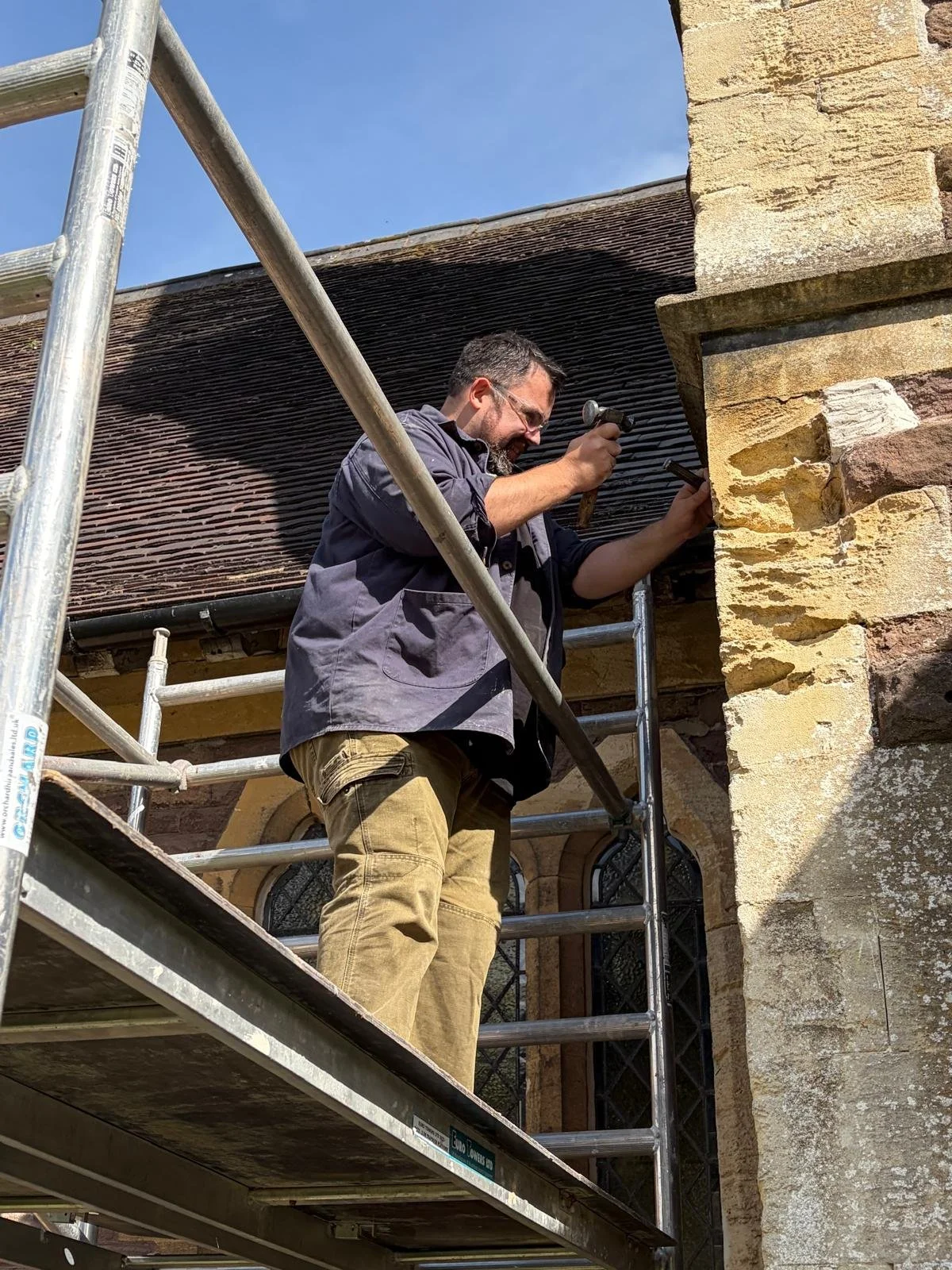
Knocking out old cementitious mortar repairs and preparing for lime repairs. Copyright M.Kenney
On Friday 25th September, I joined a working party made up of professional stonemasons and lay-volunteers to learn some new skills in stone masonry and lime mortar repair. Organised by Falcon & Gilbert Scott in partnership with the Gloucester Diocese, we rolled up our sleeves and got to work on the Grade II listed St. Saviour’s in the Wye Valley, with the ultimate goal of removing it from the national heritage buildings at risk register.
————————————————————————————
Britain isn’t short of a listed parochial church or two. In fact, there are about 20,000 listed cathedrals, churches, and chapels in used across the United Kingdom. Each one has been listed on its own merits, in essence because it holds some significance in context to its history and surroundings (see my article on Listed Buildings for more information). This victorian gothic revival church, then, can’t claim to be all that rare. But, as I was to find out, there is no better way to get to know a building and fall under its spell than spending a day up a scaffold tending to it’s wounds.
Designed by John Pollard Seddon (see this post for my list of architects of the ages) and built in 1873, St. Saviour’s church in Redbrook would appear to a passing motorist as a fairly typical parish church. But as we gathered, black coffee in hand, on the dew-tipped lawn of the church yard, I began to appreciate a striking example of High Victorian Gothic Revival architecture. Standing high above the A466 that meanders beside the timeless picturesque of the River Wye between Monmouth and St. Arvens, St. Saviour’s rugged, rock-faced rubble stone exterior is boldly accented by fine limestone dressings and anchored by a distinctive inset octagonal bell tower.
Its traditional layout features a four-bay nave that flows into an 1887 chancel and transept extension, creating a cruciform liturgical plan. Inside, the space is defined by its expressive structural carpentry, highlighted by an entirely boarded ceiling supported by dramatic, cusped trefoil trusses that frame a sense of reverence and draw the eye forward towards the high altar.
Listed in 1982, St. Saviour's Church was quickly added to the national Buildings at Risk Register in 1984. The primary driver for its inscription was severe stone decay. The church's red sandstone and Bath stone suffered accelerated erosion from the nitrous oxide and sulphur dioxide smog generated by the nearby Redbrook Tinplate Works, which settled thick into the narrow gorge of the Wye Valley. While it remains on Historic England's Heritage at Risk Register under the Diocese of Gloucester, extensive ongoing structural conservation and community adaptation work are steadily moving the building toward the prospect of being safely removed from the list. I was pleased to be able to play a small part in helping this venerable old church remain a focal point for the Redbrook community for many more years to come.
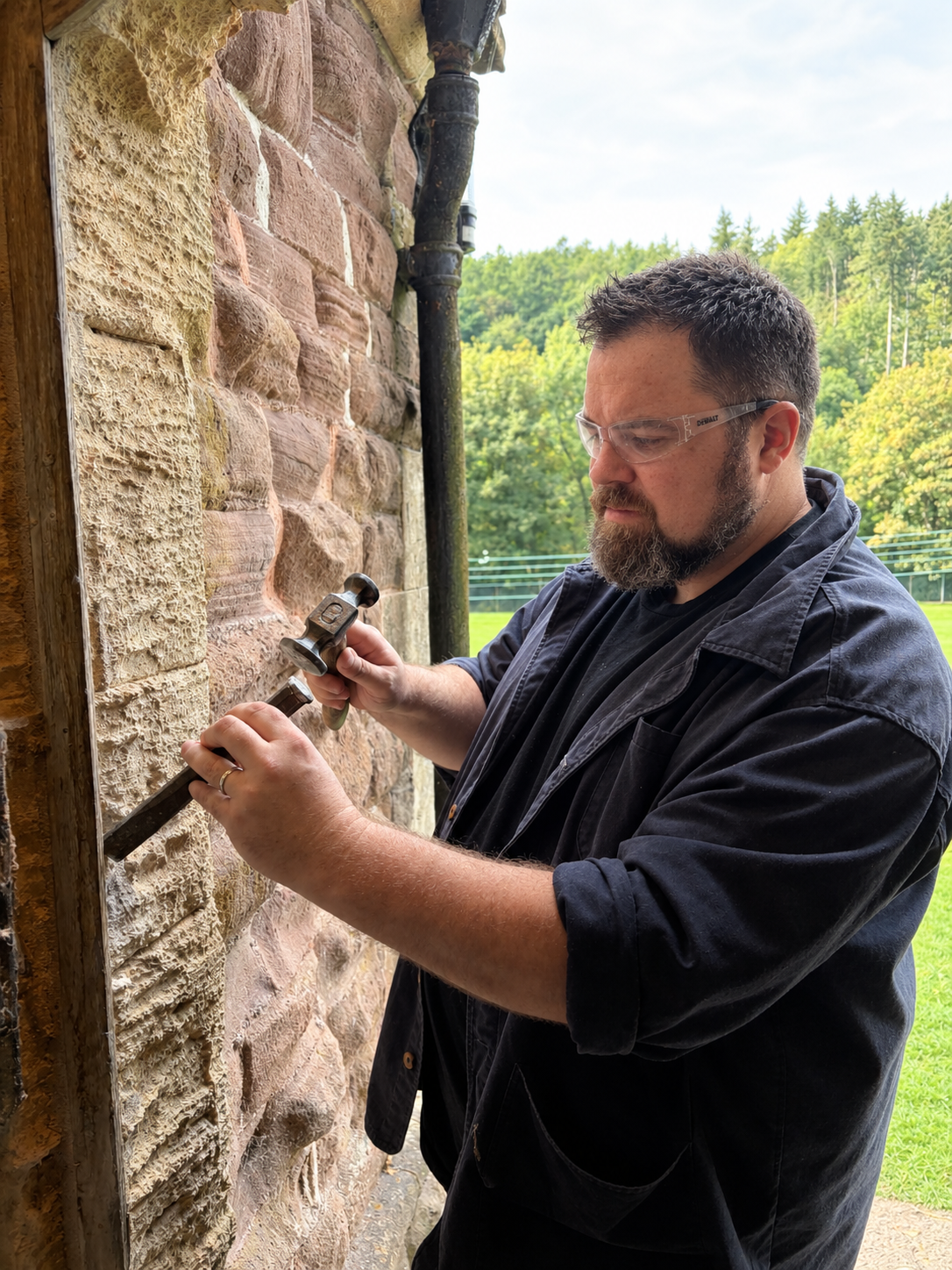
Stripping out some old cementitious mortar repairs around the gothic arch doorway into the vestry and bell tower. Copyright M Kenney.
I was assigned to repairing parts of the bell tower where the masonry had corroded very badly, and where cement-based repairs had been applied in the past. The sandstone blocks and limestone quoins and fenestrations are very soft and porous in many areas. As a result, cementitious mortar is inappropriate for pointing and mortar repairs, tending to trap moisture behind the cement and thus speeding up deterioration of the surface.
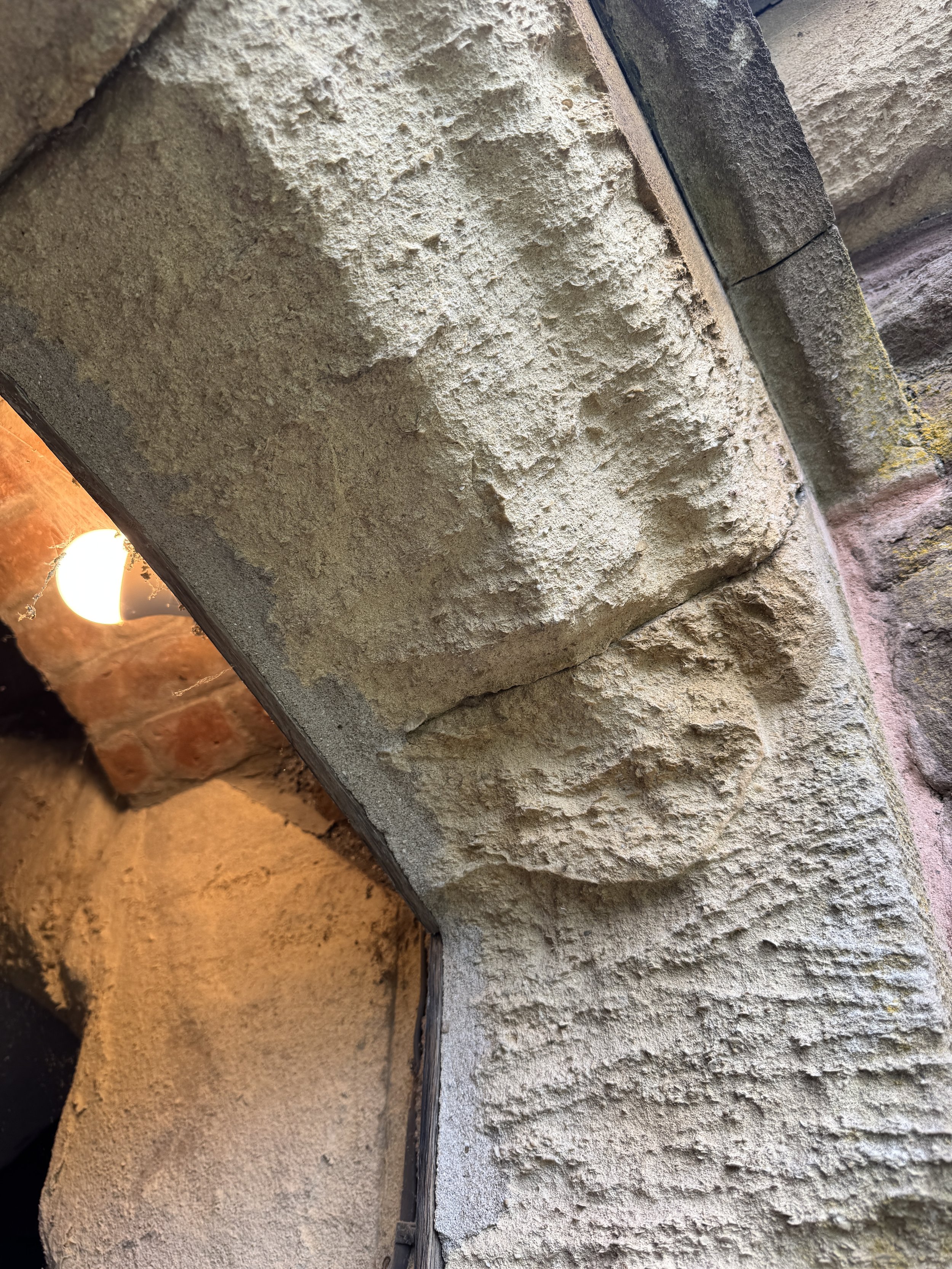
The oak door frame had previously been secured with cementitious mortar against the limestone arch and needed removing. Copyright M Kenney
One of many new techniques I learned and practiced on the day was the humble “clay tile repair”. After my initial misapprehension that I might be sent up on the roof was quashed, I came to realise that the term refers to the inclusion of clay tile to add a structurally advantageous matrix to a mortar infill repair.
Now, wherever possible, it’s preferable that stone blocks be replaced with a matching stone of the same (or very similar) constitution. Naturally, stone must be sourced, transported to site, and then handled, shaped and finished by a skilled mason. The reality is that diocese facing cost pressures and dwindling rural congregations must prioritise these types of skilled repair to where they will be most impactful. Matching the red sandstone at St. Saviour’s is quite difficult and, given the sheer extent of the chemical decay, would be a very expensive undertaking for a church without a regular and generous congregation to help fund the repairs. The clay tile repair, while at times considered a cheat to stone masonry, represents a much more cost effective method of repairing the fabric and ensuring its survival in the short term. A similar technique is to place some gallets (stone chips) into a mortar repair to provide a similar binding medium.
Weather or not you appreciate the resultant aesthetic, its important to bear in mind that these types of repair are reversible at any time, perhaps when a building’s fortunes take an upturn and some more funding is found to conduct a proper like-for-like repair. I can’t help but picture a day long into the future when some architectural archaeologist will be thrilled to find a c.21st century clay tile repair and perhaps even add its existence to the listing!
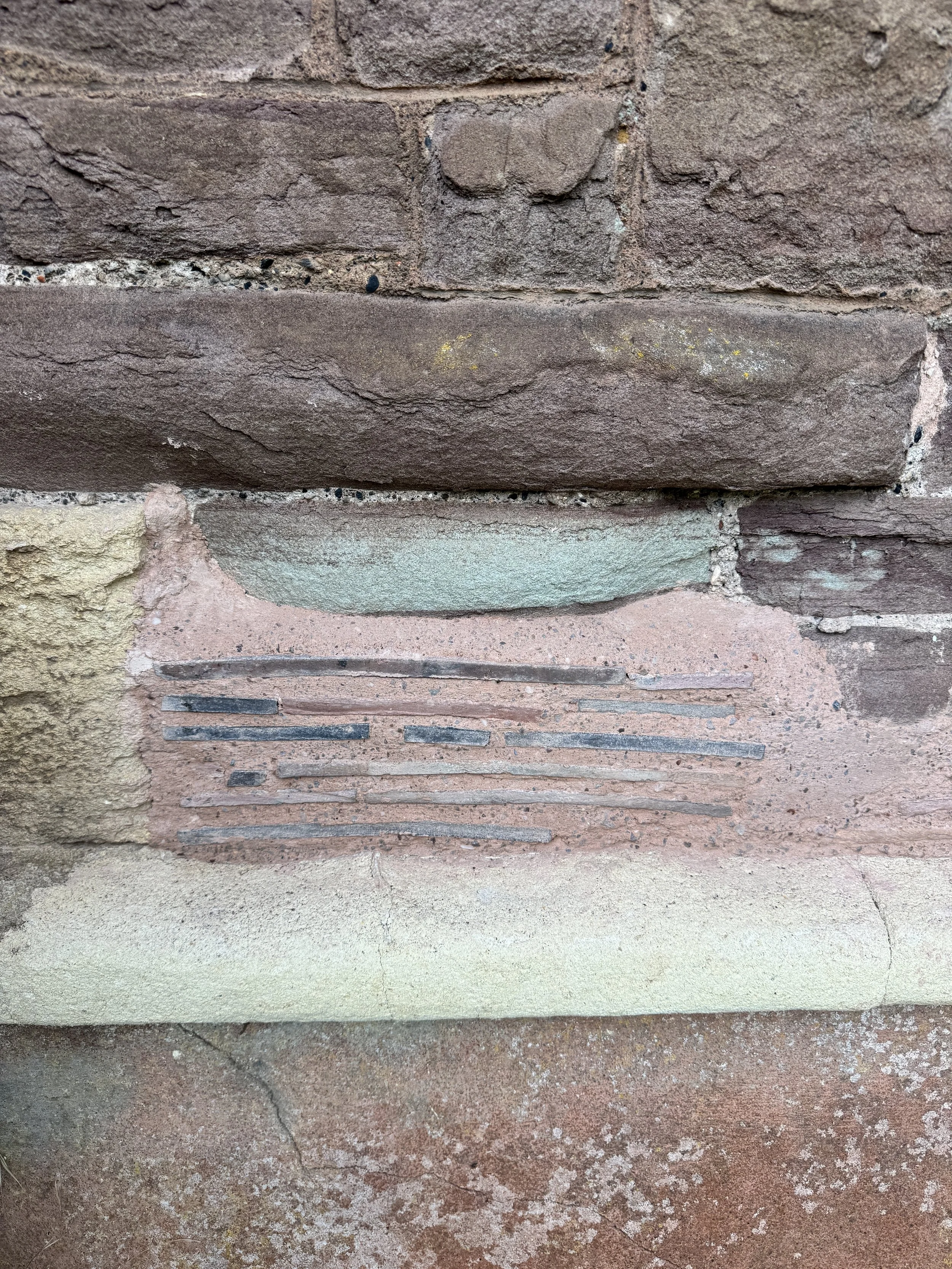
A clay tile repair at St. Saviour’s. Copyright: M Kenney