Stained Glass Gallery
This is a small collection of photographs I have taken of stained glass over the last few months. The oldest dates from the 16th Century (Henry VII’s quarry), but most date from the middle to later Victorian period. I hope you enjoy!
![[1] King's College Chapel, Cambridge](https://images.squarespace-cdn.com/content/v1/6a0c5922e279f97a33e48cfc/1787418169086-K1HNSJEM027MTSAKOLH8/IMG_4346.JPG)
![[2] Salisbury Cathedral, Wiltshire](https://images.squarespace-cdn.com/content/v1/6a0c5922e279f97a33e48cfc/1787417651386-7D2BFMNMIBCQ26AHPXVW/IMG_4196.JPG)
![[4] St. Mary's Church, Compton, West Sussex](https://images.squarespace-cdn.com/content/v1/6a0c5922e279f97a33e48cfc/1787417889023-69P4G6GT7199Z5DTCC29/IMG_5047.JPG)
![[5] Winchester Cathedral, Hampshire](https://images.squarespace-cdn.com/content/v1/6a0c5922e279f97a33e48cfc/1787417993618-TZN3G3X76VIN55JKLFEA/IMG_3581.JPG)
![[6] St. Leonard's Church, Bursledon, Hampshire](https://images.squarespace-cdn.com/content/v1/6a0c5922e279f97a33e48cfc/1787417840083-RIALM4GRLE3HA97B8JA8/IMG_4177.JPG)
![[7] Gloucester Cathedral, Gloucestershire](https://images.squarespace-cdn.com/content/v1/6a0c5922e279f97a33e48cfc/1787417720909-ZR6DUK9DMD32BHCJ9Z6N/IMG_4325.JPG)
![[8] St. Luke's Church, Milland, Hampshire](https://images.squarespace-cdn.com/content/v1/6a0c5922e279f97a33e48cfc/1787417952172-YQGTGOE81BCN9C4OD98K/IMG_5159.JPG)
[1] King’s College Chapel, Cambridge UK
Description and Meaning
The image depicts a diamond-shaped panel (historically known as a quarry) featuring a crowned hawthorn bush flanked by the Gothic monogram "H R" (Henricus Rex, referring to King Henry VII).
This motif carries significant historical and political symbolism:
The Bosworth Legend: According to Tudor lore, following the defeat of Richard III at the Battle of Bosworth Field (1485), the royal crown was discovered discarded in a hawthorn bush and subsequently placed on Henry Tudor's head.
Political Legitimacy: Henry VII adopted the crowned hawthorn bush as a personal royal badge to visually cement his hard-won claim to the English throne and celebrate the birth of the Tudor dynasty.
Date
This specific decorative quarry dates to the early 16th century, roughly between 1515 and 1531. This aligns with the final architectural phases of the chapel under Henry VIII, who completed the glazing program started by his father.
Potential Artist
While the massive, narrative main windows of the chapel were executed by prominent Flemish and German Renaissance master glaziers like Barnard Flower (the King's Glazier) and his successor Galyon Hone, smaller heraldic side-chapel quarries like this were frequently handled by their workshop assistants or specialist English artisans operating under the crown's commission.
[2] Salisbury Cathedral, Wiltshire
Description and Meaning
This striking two-light window is located in the north nave aisle of Salisbury Cathedral. It illustrates biblical themes centered around Christ's care for the young. The detailed narrative scenes are integrated entirely into the window glass without formal architectural borders or stone-imitation frames, which was a signature layout choice for this designer.
The main registers depict Christ blessing the children, flanked by four specific scriptural quotations woven into the banners across the panels:
"He shall gather the lambs in His arms and carry them in His bosom."
"In Heaven Their Angels Do Always Behold The Face Of My Father."
"Suffer the Little Children to come unto me."
"For of Such is the Kingdom of Heaven."
The base of the window bears a dedicatory inscription revealing its purpose as a family memorial: "To the honour & glory of God. In memory of John Henry Jacob & Henrietta Sophia his wife. This window is given by their children."
Date
The window was created in 1890 and unveiled to the public in 1891.
Artist
The window was designed by Henry Holiday of Hampstead, the leading stained-glass master of the Aesthetic movement. Holiday became a preeminent independent designer after working extensively with James Powell & Sons, and his distinctively colorful, richly folded drapery styles define this late-Victorian masterpiece.
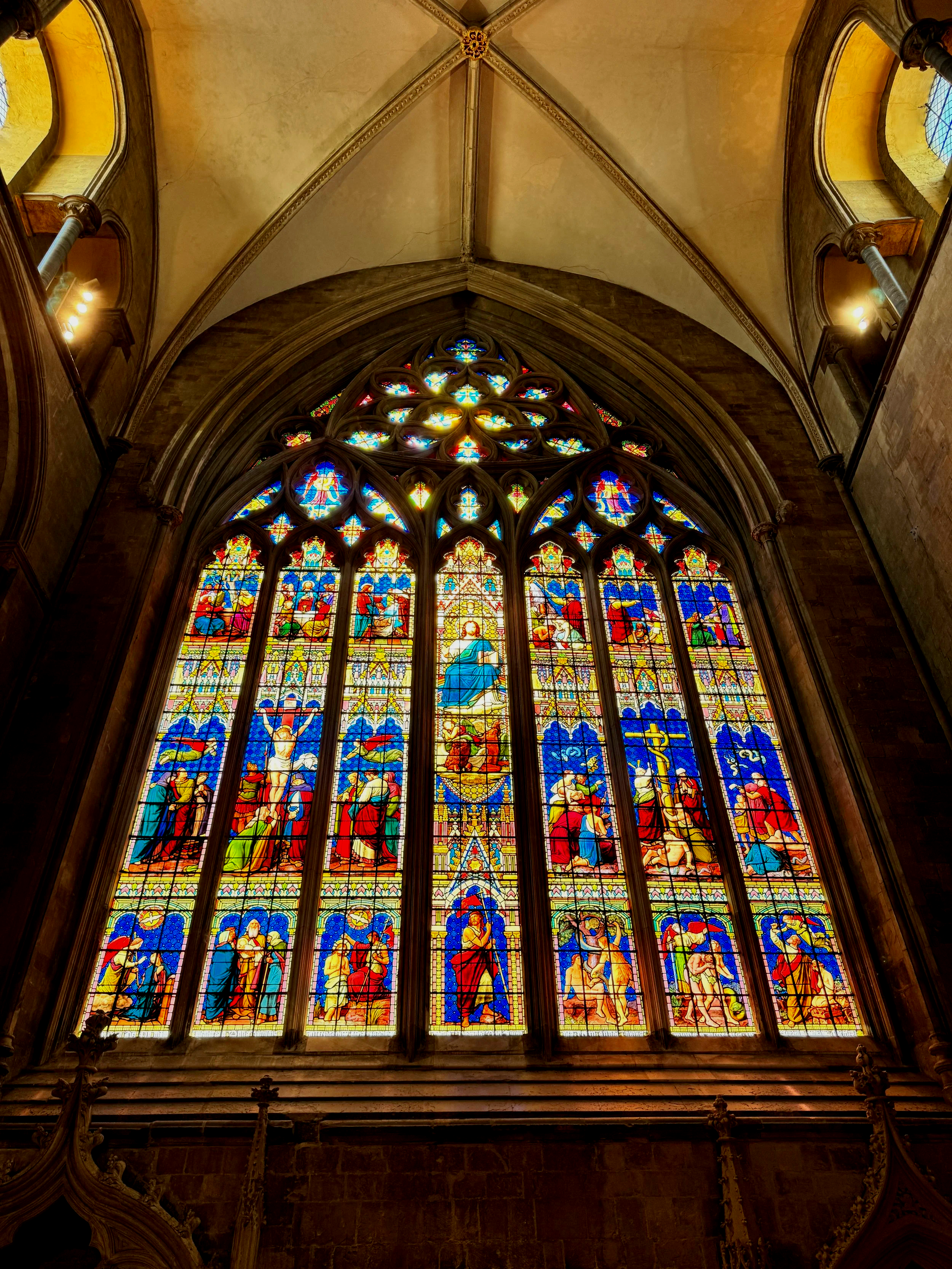
[3] Chichester Cathedral, West Sussex
Description and Meaning
This grand seven-light window in the South Transept of Chichester Cathedral depicts a comprehensive "Type and Anti-type" (or typological) narrative mapping the theological story of salvation. It is designed to create a direct dialogue between the Old and New Testaments:
The Center: Features the central image of the Resurrected Christ in Glory, surrounded by symbols of the four Gospel writers and John the Baptist.
Left-Hand Panels (New Testament Anti-types): Include scenes such as the Crucifixion, Jesus and the woman from Samaria, the Last Supper, and the raising of Jairus' daughter.
Right-Hand Panels (Old Testament Types): Unfold corresponding foreshadowing events, starting from the expulsion of Adam and Eve from Eden at the bottom right, up through Moses lifting the bronze serpent on a pole, Moses striking the rock for water, and Manna from Heaven.
Unusually for typological windows, the narrative layout here is flipped, positioning the New Testament events on the left and the Old Testament events on the right.
Date
While the intricate Gothic stone tracery was originally constructed in the early 14th century during the episcopate of Bishop John Langton (1305–1337), this stained glass itself dates to 1877.
Artist
The window architecture and layout was designed by Charles Parrish, a local architect. The stained glass windows themselves were manufactured by the highly esteemed French studio Maréchal & Champigneulle in Bar-le-Duc.
In his 1933 history book The Story of Chichester Cathedral, then Dean A.S. Ducan-Jones remarks on page 31:
“More obvious and striking is the great sumptuous South window which he (Bishop John of Langton) inserted into the wall of the South transcept. The window is one of the finest examples of decorated tracery in England. The glass unfortnately is not equal to the tracery. It was made in Bar-le-Duc in 1870, but there is good hope that better glass will presently take its place, and of a character better calculated to fulfil Langton’s obvious purpose of throwing more light on to the dark choir.”
Alas, Dean Duncan-Jones never got his wish of “better” glass, and the sumptuous Victorian Maréchal & Champigneulle stuff remains to this day, and no doubt a subject of the Cathedral’s Grade I listing!
[4] St. Mary’s Chuch, Compton, West Sussex
Description and Meaning
This tall, slender lancet window at St Mary's Church, Compton features a vibrant non-figurative ornamental design. Eschewing traditional biblical scenes, it emphasizes pure geometric patterning:
The Medallions: It centers around three large circular interlocking motifs, framing stylized rosettes and diamond shapes.
The Foliage: Delicate, monochromatic leaf scrollwork patterns fill the clear backgrounds inside the main panels.
The Borders: Brilliant borders composed of rich turquoise, primary red, deep blue, and amber glass frame the geometric centerpieces.
Date
The glass was created and installed in 1893.
Artist
The window was manufactured by the preeminent Victorian firm James Powell & Sons (Whitefriars Glass) and designed by the celebrated stained-glass master Henry Holiday.
[5] Winchester Cathedral, Hampshire
Description and Meaning
This three-light, two-tiered Perpendicular Gothic window is located in the north nave aisle of Winchester Cathedral. It serves as the official Jane Austen Memorial Window, positioned directly above her final resting place and brass memorial plaque.
The window features six prominent biblical and symbolic figures representing themes of wisdom, devotion, and character:
Top Row: St. Augustine of Hippo (representing theology), King David playing his harp (representing sacred music and poetry), and the prophetess Anna (symbolizing faithful devotion).
Bottom Row: The matriarch Sarah, King Solomon holding a model of the Temple (representing wisdom and intellect), and the faithful Ruth.
The Tracery: The upper stonework features a vivid, golden six-pointed star framing a sacred monogram, drawing the composition together.
The choice of these specific characters honors the "extraordinary endowments of her mind" and moral vision, redressing her original 1817 gravestone which famously omitted any mention of her literary achievements as a novelist. [1]
Date
The window was funded by public subscription and formally dedicated in 1900.
Artist
The window was designed and manufactured by the celebrated Victorian designer Charles Eamer Kempe, whose hallmark wheatsheaf signature can be found integrated into the artwork.
[6] St. Leonard’s Church, Bursledon, Hampshire
Description and Meaning
This three-light Gothic window serves as the main East Window of St Leonard's Church, Bursledon, which also happens to be my church! It vividly illustrates The Ascension of Jesus Christ into heaven, breaking the narrative across all three vertical panels:
The Center: Features the central figure of Christ robed in glowing white, ascending toward the heavens amid a bank of dramatic, stylised dark clouds.
Flanking Lights: Two prominent, vibrant red-winged angels bow in adoration alongside fluttering banners reading "I Am With You" and "Alway, Even Unto The End Of The World."
The Base: Portrays the twelve apostles and the Virgin Mary gathered tightly on the ground, gazing upward in absolute awe.
The lowermost border contains a deeply personal dedicatory inscription identifying it as a family memorial: "In loving memory of Rosalind, daughter..." and "In loving memory of Dora, daughter...".
Date
The original Victorian glass was severely damaged during World War II. Following a complex project, the newly restored and re-leaded window was officially re-installed and unveiled in March 1991.
Artist
The original design was executed by the master craftsman John Richard Clayton of the acclaimed Victorian studio Clayton & Bell. This firm also famously painted the matching, historic Three Maries at Christ's Tomb mural over the church's west entrance.
[7] Gloucester Cathedral, Gloucestershire
Description and Meaning
This small, beautifully detailed lancet window is located within the historic Lavatorium alcove—the communal washing area for the medieval monks—in the south walk of the Gloucester Cathedral Cloisters. Appropriately themed around water for its laundry and handwashing context, this particular panel depicts the Creation of the Sea and Sky from the Book of Genesis.
The design is rendered in a highly dynamic, pre-modern style:
The Elements: A brilliant crimson sun rises over deeply grooved, stylized swirling sea waves patterned in muted teal, beige, and white.
The Wildlife: A flock of dynamic white seabirds and gulls soar, dive, and wheel effortlessly across a deep cobalt blue sky punctuated by stylized golden stars.
The Frame: The scene is framed symmetrically by vertical borders decorated with stylized yellow floral rosettes and continuous vine motifs.
Date
The glass was installed during the Victorian restoration of the cloister plumbing and lavatory structures in 1868.
Artist
The window was manufactured by the preeminent firm John Hardman & Co. of Birmingham using vibrant, rich cartoon designs supplied by James Powell & Sons.
[8] St. Luke’s Church, Milland, Hampshire
Description and Meaning
This three-light window in St Luke's Church, Milland (the Victorian church built directly next to the medieval Tuxlith Chapel) features a poignant depiction of The Parable of the Good Samaritan.
The composition flows across the vertical stone divisions:
The Center Light: Captures the emotional heart of the story, showing the Samaritan tenderly supporting and wrapping bandages around the torso of the beaten traveler.
The Left Light: Depicts the Samaritan's faithful donkey waiting patiently on the rugged road to Jericho.
The Background Elements: Vivid architectural ruins and distant castles sit beneath an intricately rendered, towering Gothic white canopy system.
The window serves as a family memorial dedicated to George Street, a prominent local benefactor who helped fund the construction of the church.
Date
The window was designed and installed in the late 1890s (circa 1899), shortly after the completion of the main Gothic Revival church building.
Artist
The window was designed and manufactured by the celebrated independent Arts and Crafts stained-glass master Christopher Whall. His work in this church showcases his mastery of rich, naturalistic landscape tones and highly characterful facial expressions.